 Skip to content



55
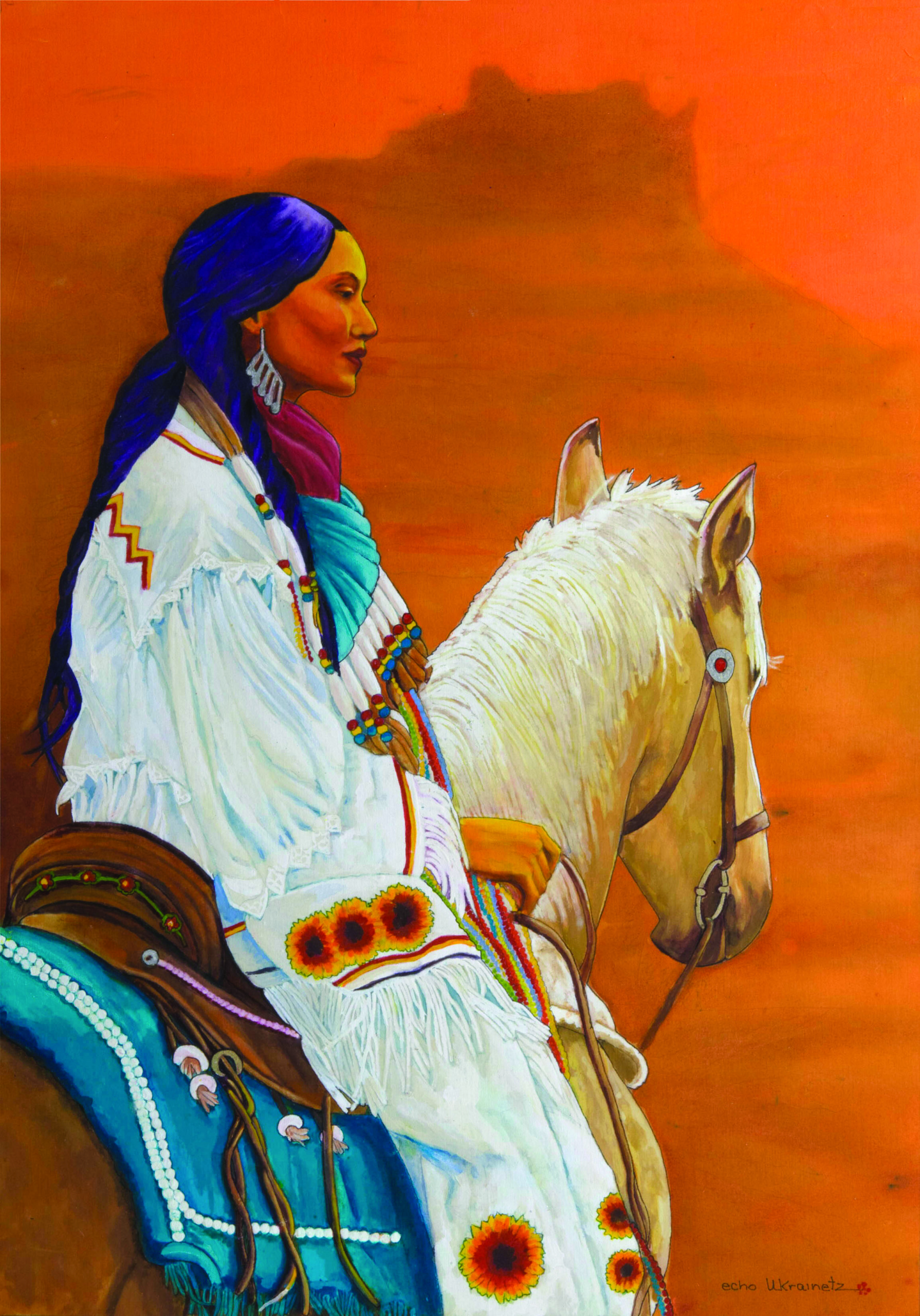
Echo Ukrainetz
Legend of The Blanket Flower
batik with gold and silver powder
30 x 21 in.
$4,500–$5,500
(Thank you, NativeShinee, for permission to use photo reference)
“Firewheel is also known as indian blanket flower (the flower shown in the beadwork), a name that comes from a legend. The story goes the braves from a native american tribe went to war, leaving behind their wives and children. Soon after, the wife of the chief began weaving a blanket for her husband. In the blanket she wove threads of red, orange, and yellow, each pattern a symbol of her prayer to the Great Spirit to keep her husband safe.
One day, the daughter of the chief was out playing in the woods and got lost. Night soon fell, and the little girl prayed to the Great Spirit to send the blanket to keep her warm during the night. She fell asleep.
The next morning, she found herself covered in flowers of the same red, orange and yellow, colors as the blanket. Her father, returning from war, found his daughter covered in the beautiful flowers. From that time on, they were called Indian blanket flowers.”
The wild species of the Blanet Flower (Gaillardia) covers the ground with a blanket of brightly colored daisy-like flowers in shades of red, orange, and yellow.
97
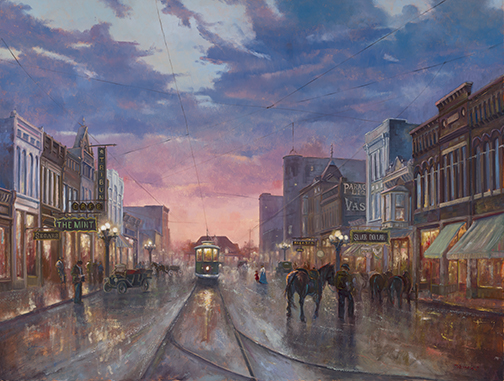
Whitney Weidow
Mint and Silver, A 1912 Glimmer
oil
30 x 40 in.
$9,000–$10,000
Sunset spills across Central Avenue in 1912, gilding brick façades, wet streets and the hum of the electric trolley car. Warm light pours from the Mint Bar and the famed Silver Dollar Saloon, two Great Falls watering holes Charles M. Russell is known to have favored. Their fronts glowing like lanterns against a setting sun. Charlie is to be seen walking his horse, Neenah, toward the Silver Dollar with a stack of small canvases tucked under his arm, a quiet, honest moment of the artist among the city’s evening bustle. Trolley wires lace the amber sky; shop windows hold the last golden minutes of the day. “Mint and Silver, a 1912 Glimmer” captures history and hush — the city that shaped a legend, and the legend who shaped the West.
132
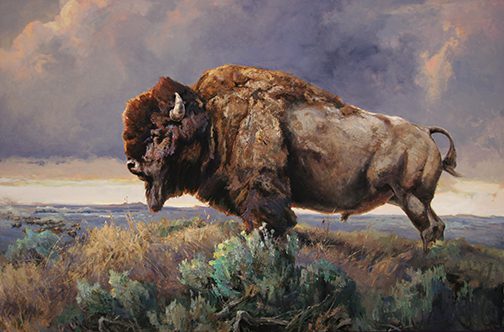
Luke Frazier
The Beginning of the End
oil
40 x 60 in.
$40,000–$60,000
A dominant herd bull buffalo stands alone as the icon of the old West. In the 1800’s there were tens of millions of American Bison roaming the western plains of the Continental U.S. What happened to their numbers after the Transcontinental Railroad was completed, was nothing short of a travesty. It is our history, and is a long and sordid tale indeed – and needs further telling, but not by me. I feel quite fortunate to have seen thriving herds of buffalo as they thunder across the prairie land of Montana, Utah, Wyoming and the Dakotas. Big shaggy bulls fighting and roaming about, stirring up dust and trouble. Even though we will never see the millions that once roamed our country, hopefully the conservation of the species will continue to grow so our great, great grandchildren can experience them as well.


134
Nancy Dunlop Cawdrey
Ruby Gems
dye on silk
21 x 50 in.
$9,000–$11,000
Iris seem to be “heritage” flowers in the American West. Early settlers traveled across our vast country with heirloom iris bulbs from their parents, grandparents and European ancestors. Over the years I have been gifted some wonderful varieties and these ruby-colored gems are some of them. One of my favorite things to do in Montana is explore long- abandoned homesteads and find the remnant iris plants. I leave them where they are.
135
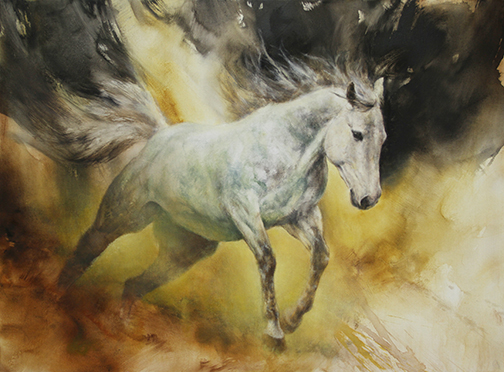
Chris Owen
Tempest
oil
30 x 40 in.
$15,000–$22,000
The horse is captured in a moment of unrestrained motion, representing a spirit of freedom and raw natural energy to bring the image to life, and highlighting his power and grace.
Its dominant musculature is defined by the interplay of light and shadow, capturing the essence of strength and vitality, a sense of speed, and a feeling of being unshackled.
151
Brent Cotton
The Deer Hunter
oil
24 x 32 in.
$14,000–$18,000
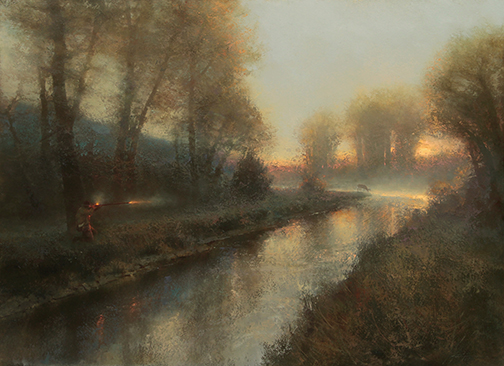
The Deer Hunter is an homage to the mountain men and longhunters, rooted in my own lived experience as a deer hunter. The scene depicts a moment I have personally known; a flintlock fired in muted autumn light, smoke lifting and dissolving into mist as the landscape absorbs the sound and motion.
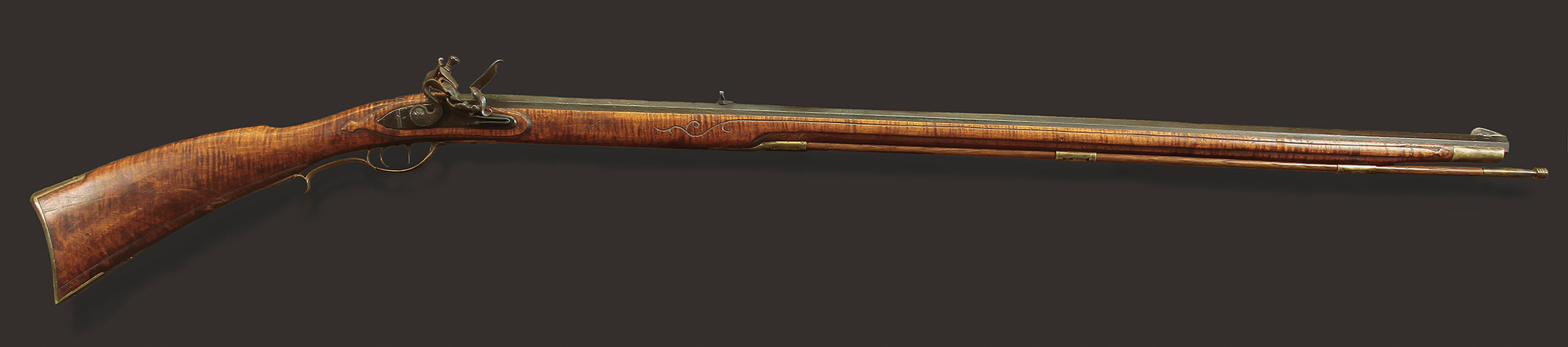
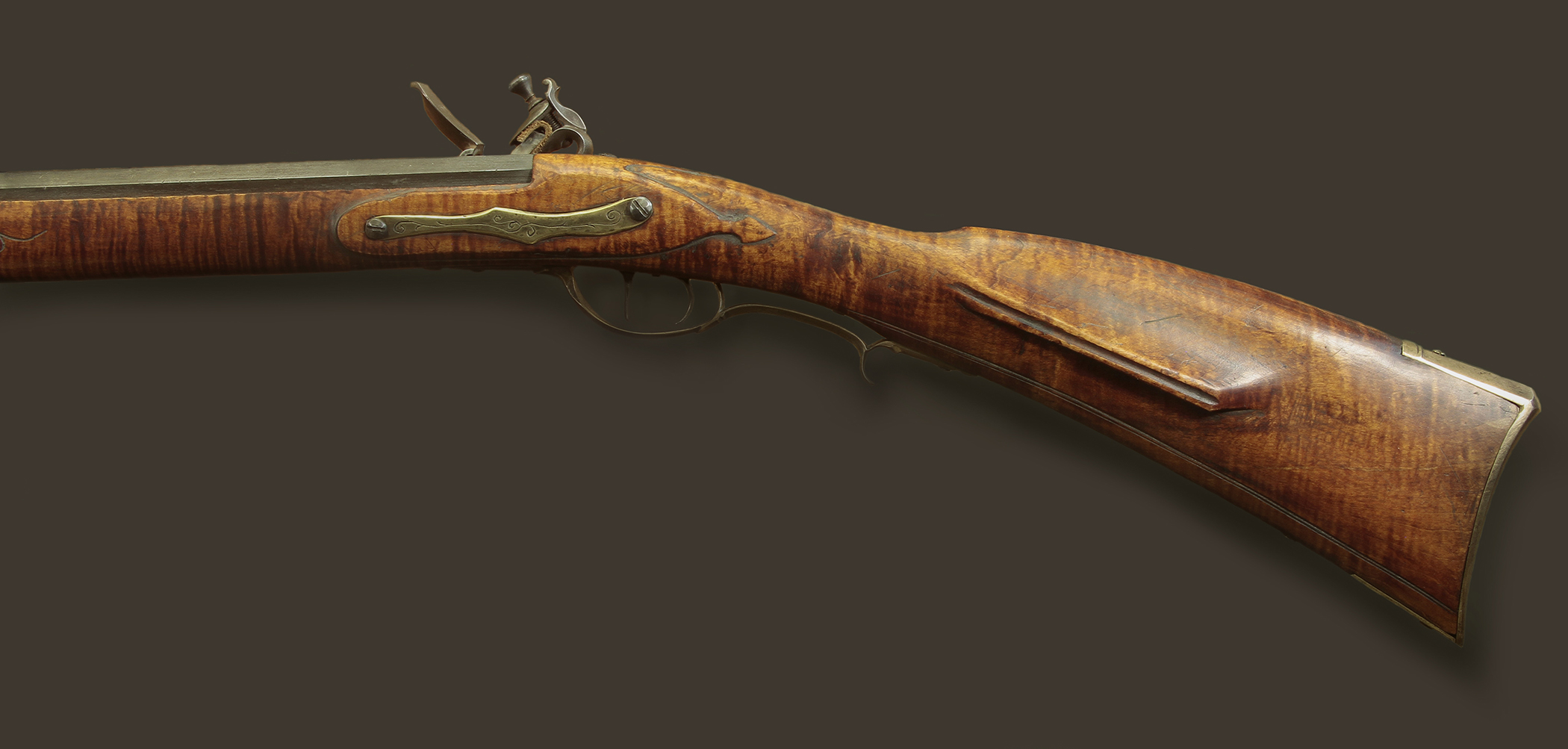
The painting is accompanied by a Lehigh-style flintlock rifle in .45 caliber, built by me as a companion piece and
representative of rifles commonly carried during those eras. It features a hand-carved curly maple stock and antiqued to suggest careful use over time. Together I hope that the painting and the rifle speak to my love of tradition, respect for the land, the animal, and the enduring craft that binds them.
Rifle included to the successful bidder.
158
Gary Lynn Roberts
Montana Memories
oil
44 x 68 in.
$50,000–$60,000
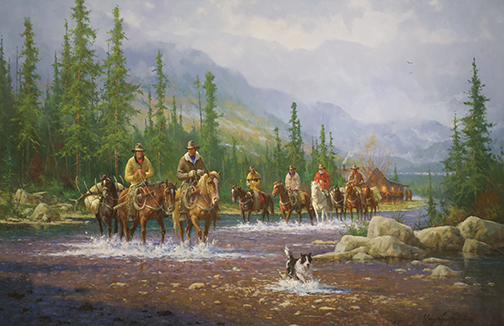
Living in the Bitterroot Valley has given me the unique pleasure of listening to hunting stories among friends. This painting depicts a beautiful memory of a successful hunt.
When painting a large painting such as this, I often paint small color studies first to give me an idea of the direction I would like to go.
Upon the suggestion of some artist friends, I have carried the color studies a little further. I have enjoyed many stories over the years, and it is a privilege to share them with you.
A collection of the studies created exclusively for this piece accompanies this lot.
159
Jeremy Winborg
Pitamakan—Dawn of a Horse Thief
oil
48 x 37 in.
$27,000–$33,000
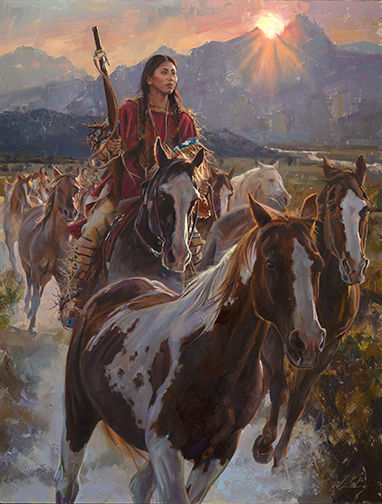
Dawn of a Horse Thief portrays the young Blackfeet warrior Pitamakan returning at sunrise from a night raid, riding at the head of the captured herd with her father’s rifle raised. Her father had died in battle when she was young, and she inherited his rifle along with his role as provider and protector for the family. She would dress as a boy and sneak out on night raids to steal horses. She became respected in her tribe as an excellent horse thief and after many successful raids, she distinguished herself as a warrior and led her own expeditions. Her horse thievery made her well-known among enemies, and any warrior who killed her would gain honor from it. Unfortunately, Pitamakan died around 1836 while leading a war party. Through oral histories and artworks like this, Pitamakan’s courage, skill, and legacy live on. Her calm strength in her moment of return is preserved for us to remember. A collection of studies created by the artist exclusively for this piece accompany this lot.
171
Tobias “Toby” Sauer
She Stood Tall
oil, Sharps rifle
30 x 40 in.
$17,000–$19,000
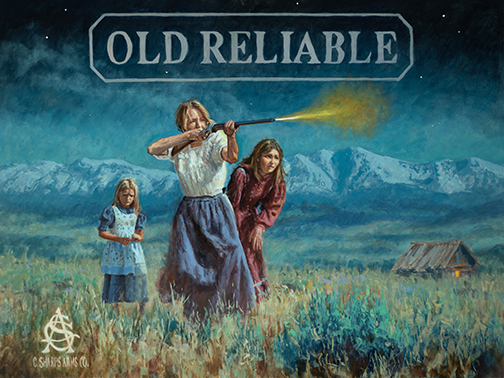
With beauty, resolve, and Old Reliable — She Stood Tall.
The woman at the center of this painting is fictional, but her story is not.
She represents the countless women who stood at the edge of the Montana frontier in the late 1870s and 1880s—often alone, often unseen, and often responsible for far more than history records. While rail lines pushed west and settlements took root, homesteads were held together not by law or distance, but by resolve. In those moments when help was days away and danger moved quietly through the dark, the responsibility to protect home and family rested on a single figure.
In She Stood Tall, that responsibility is neither romanticized nor exaggerated. It is simply present.
The scene unfolds at night, when isolation is most complete. A lone woman fires a shot into the distance. Behind her, the cabin glows with life. Her children stand close—not hidden, not panicked, but aware. This is not a moment of chaos. It is a moment of decision.
The rifle she carries is a Sharps Model 1874 Business Rifle.
Introduced as Sharps’ answer to the realities of frontier life, the Business Rifle was intended to be accessible without compromise—an affordable working rifle that emphasized quality, accuracy, and reliability. It was not built for display. It was built for use. For settlers, ranchers, hunters, and families living beyond the reach of immediate protection, the Business Rifle represented confidence in craftsmanship when it mattered most.
In 1878, a shipment of fifty Sharps rifles—including the Business Rifle—was sent to Walter Cooper in Bozeman, MT.
Cooper was a prominent figure in early Montana commerce, supplying firearms and goods to a rapidly growing frontier population. That shipment places this rifle, and rifles like it, directly into the hands of those shaping Montana’s early communities. It is notable history that the original rifle upon which this modern example is based passed through Cooper’s shop—bridging archival record and lived experience.
In this painting, the rifle is not the story. It is part of it.
She Stood Tall completes a trilogy that explores foresight, identity, and stewardship. Where earlier works considered preparedness and reflection, this final image confronts responsibility—quietly, decisively, and without spectacle. The unseen threat matters less than what stands in its way.
The frontier was not settled by lone gunmen or singular acts of violence. It was settled by families who endured, by individuals who stood when no one else could, and by tools that did their work reliably, night after night.
This painting honors that truth.
Rifle included to the successful bidder.
177
Kim Randleas
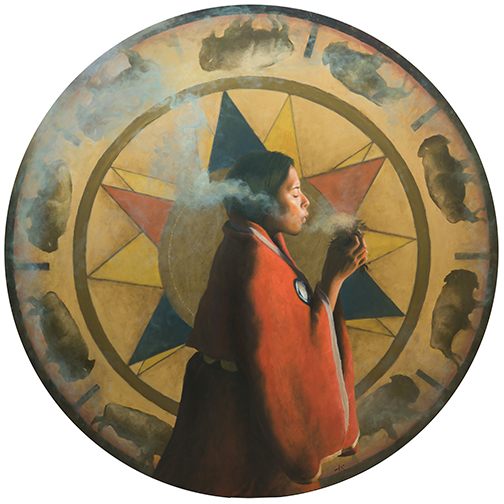
Buffalo Running, 1883
oil , praxinoscope
48 in. rond panel; 5½ x 9 x 9 in.
$10,000–$12,000
Buffalo Running, 1883 pairs an original oil painting with a praxinoscope created by the artist that animates bison from Eadweard Muybridge’s motion studies. Inspired by Victorian-era invention and the birth of cinema, the work reflects both the thrill of technological progress and the cultural upheaval reshaping Native American life in the late 19th century. Scan the code to see the praxinoscope in motion.

180
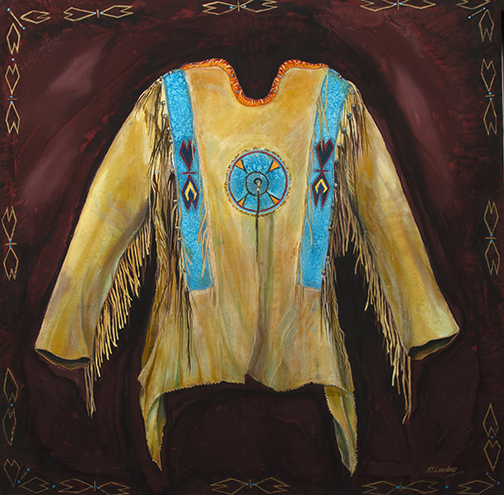
Nancy Dunlop Cawdrey
Blackfoot Heritage
dye on silk
36 x 36 in.
$12,000–$14,000
“Blackfoot Heritage” – This shirt was worn in a Blackfoot Sundance near Fort Belknap, Montana somewhere in the 1890’s. My family was invited to give support to the Sundancers near Mouse Canyon a few years back. When I read the provenance of this shirt, I felt moved to honor that tradition in this painting. Sundancers dance and pray for ALL of us.
186
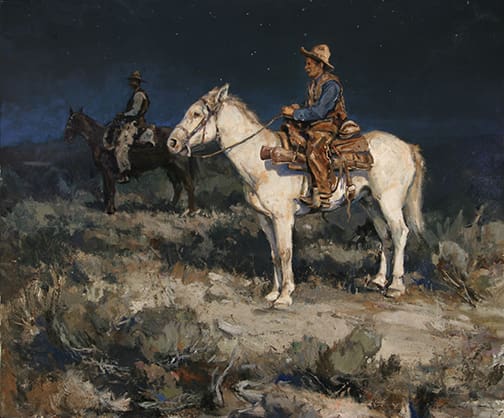
Luke Frazier
Buffalo Hunters
oil
30 x 36 in.
$25,000–$35,000
After the Civil war, white settlers began to push westward – and at that time vast herds of buffalo roamed freely across the Great Plains of North America. The buffalo provided an invaluable source of food and clothing, mainly in hides and other materials for Plains Indians and settlers alike.
Army posts scattered towards the Pacific, the big push west had begun, and it attracted men like Wyatt Earp, Wild Bill Hickok, and William F. Cody. These men were buffalo hunters, and were among hundreds of men trying to capitalize on the millions of buffalo in the untamed west. With the completion of the transcontinental railroad, and after when the Union Pacific was completed in 1869, it became possible to ship hides from the Great Plains to eastern markets for a profit. Sadly, thousands of hunters arrived and hundreds of thousands of buffalo were hunted to near extinction.
188
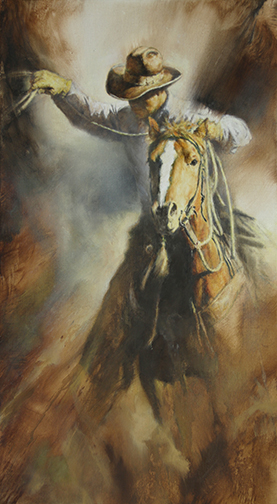
Chris Owen
Timing it Right
oil
36 x 20 in.
$10,000–$15,000
The timing and skill required in a working ranch environment is important, particularly when roping. “The precise synchronization between the horse’s movements, the cowboy’s position, and the animal’s dynamic stride stresses the complexity of the task, where timing is paramount to a successful catch. The cowboy’s daily work shows an incredible blend of anticipation, coordination, and athletic competence from both the cowboy and the animal.” The timing of his horse’s stop is a key part of the equation, and it is necessary that he can fit his throw and stop into that sequence.